The Iranian Experience in Using Centralization and Decentralization and Its Emergence in Managing Conflict with the United States
Introduction
This study discusses the concept of centralization and decentralization in management science and their relationship to decision-making within organizations and states. It also attempts to link these concepts to Iran’s experience in managing political and military conflicts, particularly in dealing with American pressure, as a model that combines two different administrative approaches.
First: Definition of Centralization and Decentralization in Management
Centralization and decentralization are two opposite administrative systems in the way authority and decision-making are distributed within any organization.
Definition of Centralization
Centralization is an administrative approach in which decision-making authority is concentrated in a single higher-level body responsible for directing the rest of the organization.
It is used in governments, large institutions, and complex systems.
Advantages of Centralization:
-
Clear leadership
-
Fast decision-making in critical situations
-
Unified policies and standards
-
Easier control and supervision
Disadvantages of Centralization:
-
Slow response in some situations
-
Weak participation from lower levels
-
Reduced innovation and creativity
-
High responsibility concentrated at the top in case of failure
When Centralization is Used:
-
In crises and disasters
-
When decision unification is required
-
When resources and expertise are concentrated in one place
-
In new or unstable systems
-
When strict control is needed
Definition of Decentralization
Decentralization is an administrative approach in which decision-making authority is distributed across multiple levels within an organization or state instead of being concentrated in one center.
Advantages of Decentralization:
-
Flexibility in decision-making
-
Encouragement of innovation and creativity
-
Increased participation
-
Reduced pressure on the central authority
-
Development of multiple leaders
-
Reduced impact of total system failure
Disadvantages of Decentralization:
-
Variation in service quality
-
Possible conflict between decisions
-
Higher administrative costs
-
Need for highly qualified local personnel
When Decentralization is Used:
-
In large organizations with multiple branches
-
When innovation is required
-
In geographically dispersed regions
-
When increasing local participation is desired
Second: Combining Centralization and Decentralization
In many modern systems, a hybrid approach is used to balance both models.
This system is known as a hybrid administrative structure, where:
-
Strategic decisions are centralized
-
While implementation is partially decentralized
Third: The Iranian Experience in Conflict Management
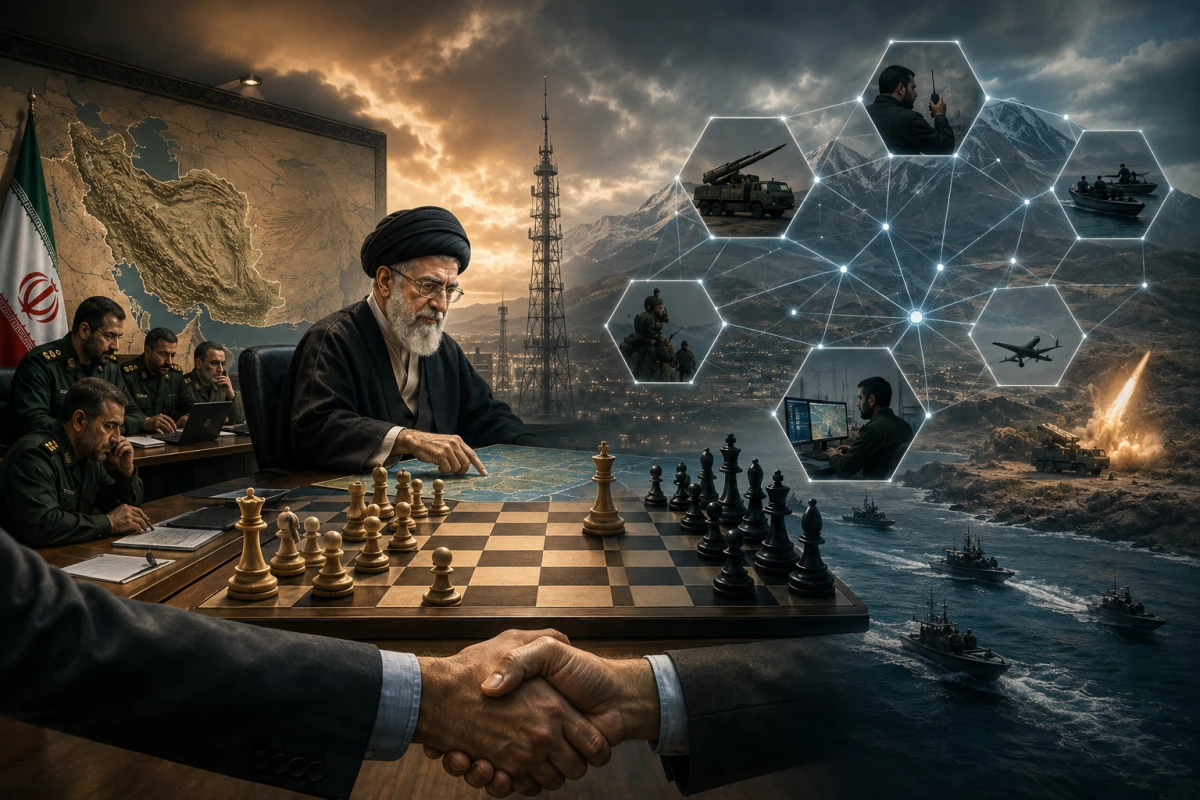
The Iranian experience can be considered an example of an administrative system that combines centralization and decentralization in managing political and military affairs, especially in dealing with American pressure.
1. Decision-Making and Strategic Planning
Iran relies on a clear centralized system in major strategic decisions, especially in:
-
Military planning
-
Foreign policy decisions
-
Sensitive security issues
At the same time, some operational flexibility is granted to lower levels in:
-
Field implementation
-
Local operational management
-
Adaptation to field conditions
2. Leadership Development and Capacity Building
The experience shows a focus on building multi-level leadership, rather than relying on a single leader.
This includes:
-
Preparing second and third leadership tiers
-
Distributing responsibilities
-
Ensuring continuity in case of leadership loss
This reflects an important management principle: reducing dependency on individuals and strengthening system resilience.
3. Negotiation and Interest Management
In negotiations, a mixed approach is used:
-
Centralized determination of strategic goals
-
Flexible tactical execution during negotiation processes
Negotiation is also used as a tool within broader political pressure management, taking into account economic and regional conditions.
4. Field Flexibility
Some operational movements show a decentralized pattern, such as:
-
Diversity in response methods
-
Multiple executing entities
-
Fast adaptation to changing conditions
Fourth: Results of Combining Centralization and Decentralization
Combining both systems can lead to positive outcomes, including:
-
Clear strategic vision
-
Diversity of solutions and alternatives
-
Higher decision-making efficiency
-
Reduced error rates
-
Improved adaptability
-
Better resource utilization
However, the success of this integration depends on:
-
Clear definition of authority
-
Strong coordination between levels
-
Availability of qualified personnel
-
An effective control system
Conclusion
The study of centralization and decentralization shows that neither system works perfectly alone. The most effective approach in many organizations and states is a balanced combination of both.
In the Iranian case, an administrative model combining centralized strategic direction and decentralized operational flexibility can be observed, contributing to adaptation under pressure while maintaining unity of strategic decision-making.