Following the recent attacks on U.S. military bases in the Arabian Gulf, I began thinking about military deterrence strategies among states—particularly Japan, which maintains a pacifist constitution and relies on Self-Defense Forces while living in a region surrounded by nuclear-armed states.
While researching the subject, I came across the history of biological experiments conducted by the Japanese military on prisoners in China during World War II as part of biological weapons research. This reminded me of several well-known incidents, including the assassination of former Russian intelligence officer Alexander Litvinenko in London using a radioactive substance, and the 2001 anthrax letter attacks in the United States.
This raises several questions:
-
Why do states seek to possess nuclear, biological, or other unconventional weapons?
-
What are the potential consequences of these weapons?
-
Are there limited-scale nuclear or biological weapons designed to target specific individuals?
-
What measures can reduce the risks posed by such weapons?
Why Do States Seek Unconventional Weapons?
States pursue advanced and unconventional weapons for several reasons:
-
Deterrence and protection of national security.
-
Political influence and international prestige.
-
Economic interests and the development of defense industries.
-
Maintaining the balance of power between rival blocs.
-
Compensating for weaknesses in conventional military capabilities.
-
Improving preparedness for radiological, biological, or technological emergencies.
-
Advancing peaceful applications, such as nuclear energy production.
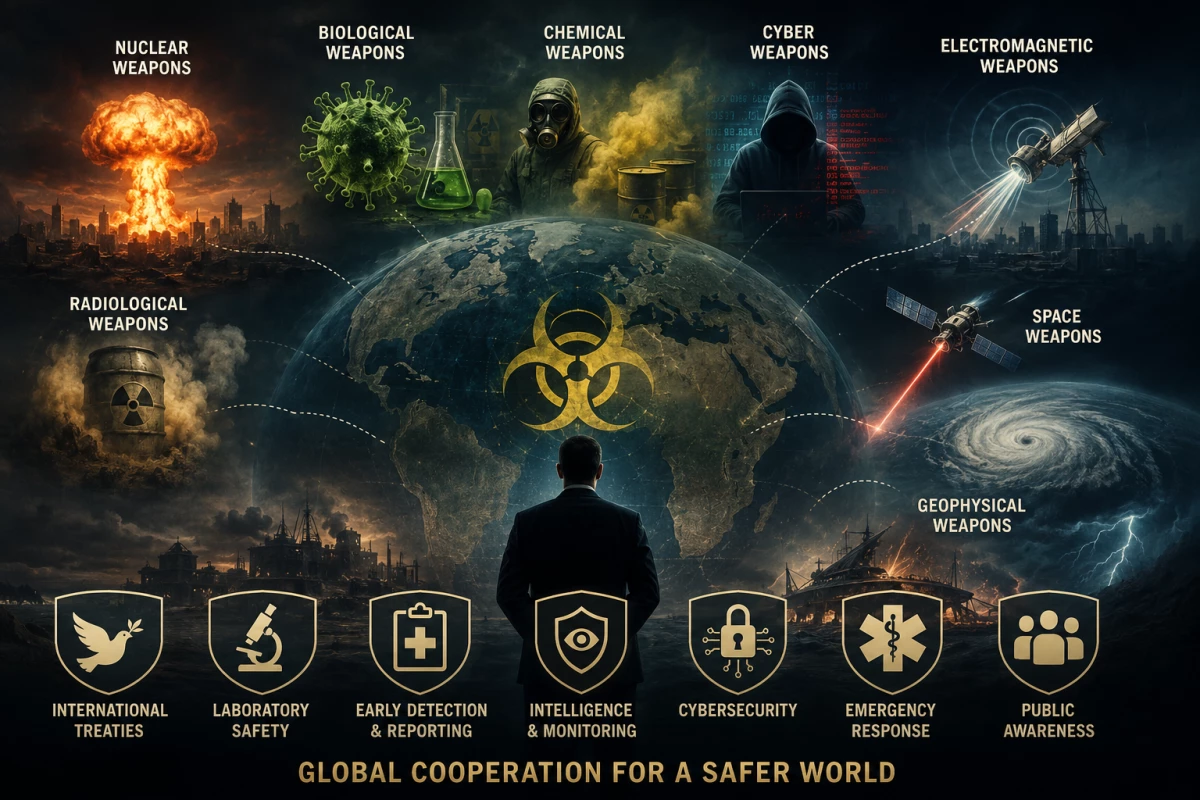
Types of Unconventional Weapons
Nuclear Weapons
Nuclear weapons rely on nuclear fission or fusion to release enormous amounts of energy.
Potential effects: Massive destruction of cities, extreme heat, powerful blast waves, and long-term radioactive contamination that increases cancer risk and causes genetic damage, as demonstrated in Hiroshima and Nagasaki.
Biological Weapons
These involve the deliberate use of microorganisms (bacteria, viruses, fungi) or their toxins to spread disease.
Potential effects: Severe outbreaks affecting humans, animals, or crops. Biological agents may spread beyond their intended target and become difficult or impossible to contain.
Strategic value: Often described as the "poor man's nuclear weapon" because they may require fewer resources than nuclear weapons while potentially causing severe economic and public health disruption.
Chemical Weapons
Chemical weapons employ toxic chemicals to kill or incapacitate.
Potential effects: Respiratory failure, burns, nervous system damage, paralysis, and death, together with environmental contamination.
Strategic value: They may be intended to incapacitate military forces and create psychological fear.
Radiological Weapons ("Dirty Bombs")
These combine conventional explosives with radioactive materials.
Potential effects: Unlike nuclear explosions, they primarily spread radioactive contamination over a wide area, leading to costly cleanup operations and long-term health concerns.
Strategic value: Their primary impact is psychological, economic, and disruptive rather than immediate mass destruction.
Cyber Weapons
Advanced malware and cyber tools designed to attack computer networks and critical infrastructure.
Potential effects: Disruption of electricity grids, communications, transportation systems, healthcare services, and theft of sensitive information.
Strategic value: They are relatively inexpensive, difficult to attribute quickly, and capable of causing significant disruption without conventional military action.
Electromagnetic Weapons
These include electromagnetic pulse (EMP) weapons generated either by high-altitude nuclear detonations or specialized high-power microwave systems.
Potential effects: Damage to electronic systems, communications, power grids, and military equipment.
Strategic value: Disrupting command, control, and technological infrastructure.
Space Weapons
Weapons intended to operate in or target assets in outer space.
Potential effects: Destruction or interference with satellites used for communications, navigation, reconnaissance, and military operations.
Geophysical Weapons
Claims have occasionally been made regarding technologies capable of manipulating natural phenomena such as weather or seismic activity for military purposes.
Current scientific assessment: There is no credible public scientific evidence that any country possesses operational weapons capable of deliberately triggering earthquakes, tsunamis, or hurricanes as military tools.
White Phosphorus
White phosphorus is not classified as a weapon category by itself but as an incendiary munition.
Its lawful military uses include producing smoke screens, illumination, and marking targets. However, when used improperly in populated areas, it can cause severe burns and raise serious humanitarian and legal concerns under international humanitarian law.
Are There Limited-Scope Nuclear or Biological Weapons Designed to Target Individuals?
Directed-Energy Weapons and Havana Syndrome
-
Location: Havana, Cuba (first reported in 2016), with later reports from several countries.
-
Reported targets: U.S. and Canadian diplomats and intelligence personnel.
-
Hypothesized cause: Some researchers suggested exposure to directed radio-frequency or microwave energy, while other scientific investigations have proposed alternative explanations.
-
Current scientific consensus: No definitive cause has been established, and there is no publicly available evidence confirming the use of a directed-energy weapon.
Claims that similar symptoms occurred in other countries remain unconfirmed.
Claims involving "energy centers," paranormal mechanisms, or similar concepts are not supported by credible scientific evidence.
Radiological Assassination
Alexander Litvinenko (London, 2006)
-
Victim: Former Russian intelligence officer Alexander Litvinenko.
-
Substance: Polonium-210.
-
Effects: Acute radiation syndrome leading to death after several weeks.
-
British public inquiry concluded that the killing was probably approved at senior levels of the Russian state, a conclusion rejected by Russia.
Cyber Weapon Example: Pegasus
Pegasus, developed by Israel's NSO Group, became internationally known after investigations published in 2021.
It has reportedly been used by multiple government agencies against journalists, activists, politicians, and officials.
Its purpose is digital surveillance through sophisticated smartphone exploitation.
Biological Weapon Example: Anthrax Letters (United States, 2001)
Following the September 11 attacks, letters containing anthrax spores were mailed to media organizations and members of Congress.
The attacks caused several deaths and widespread public fear.
The FBI later concluded that the perpetrator was Bruce Ivins, a U.S. biodefense researcher, although aspects of the case remain debated.
Chemical Weapon Example
Kim Jong-nam was assassinated at Kuala Lumpur International Airport in 2017 using the VX nerve agent, according to Malaysian authorities and international investigations.
Reducing the Risks of Unconventional Weapons
Possible measures include:
-
Strengthening compliance with international treaties prohibiting chemical and biological weapons and limiting nuclear proliferation.
-
Maintaining strict biosafety, chemical safety, and radiological safety standards in laboratories.
-
Prompt international reporting of disease outbreaks or radiological incidents.
-
Preventing the use of biological or chemical agents for political assassinations or terrorism.
-
Careful personnel screening and ongoing security and reliability assessments in sensitive facilities.
-
Improving emergency medicine and forensic capabilities to recognize rare poisonings and unusual causes of death.
-
Ensuring that laboratories operate under professional oversight insulated from political conflicts.
-
Training law enforcement and emergency responders to investigate unusual or unexplained incidents.
-
Expanding laboratory capabilities for toxicology, forensic chemistry, radiological analysis, and pathogen identification.
-
Protecting personal data, including location, medical, and financial information, from unauthorized access.
-
Conducting transparent investigations into suspected assassinations and publicly reporting verified findings.
-
Ensuring that facilities handling hazardous biological, chemical, or radioactive materials maintain robust contingency plans for natural disasters, armed conflict, and long-term maintenance.
Finally, it is worth noting that many technologies developed in nuclear, biological, and chemical sciences have important peaceful applications. Nuclear science contributes to electricity generation and cancer treatment, while biological research has led to vaccines and life-saving medicines. Conversely, scientific discoveries originally intended for peaceful purposes can sometimes be misused for military or criminal ends, underscoring the importance of strong international oversight, ethical governance, and responsible scientific practice.